
Edward Wall, Portfolio Specialist at Morningstar South Africa
People are living and are expected to live for longer
The life expectancy of humans has doubled over the past decade, according to the WHO. What is noticeable in the data is that there remains a gap between countries, with developed countries typically having a higher life expectancy than developing nations. There is a strong correlation between a country’s healthcare spending and its life expectancy.
Healthcare expenditure per capita vs life expectancy
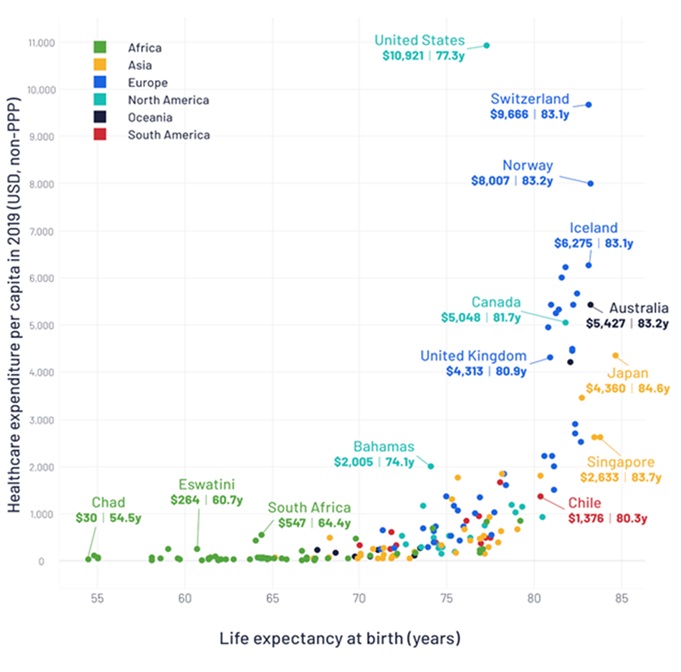
Source: World Bank Global Health Expenditure Database 2019. Chart created by Genuine Impact.
According to experts, the gap between developed and developing nations is expected to decrease over time as they play catch-up, with health care and access to it improving.
Significant contributors include improvements in nutrition, sanitation, and clean water; the development of vaccines and antibiotics; enhanced neonatal and maternal healthcare; and increasingly higher living standards. Socioeconomic progress, characterised by higher incomes and poverty reduction, has facilitated greater access to healthcare and healthier lifestyles.
Estimated years of life expectancy at birth from 1950-1955 to 2095-2100 (projected)
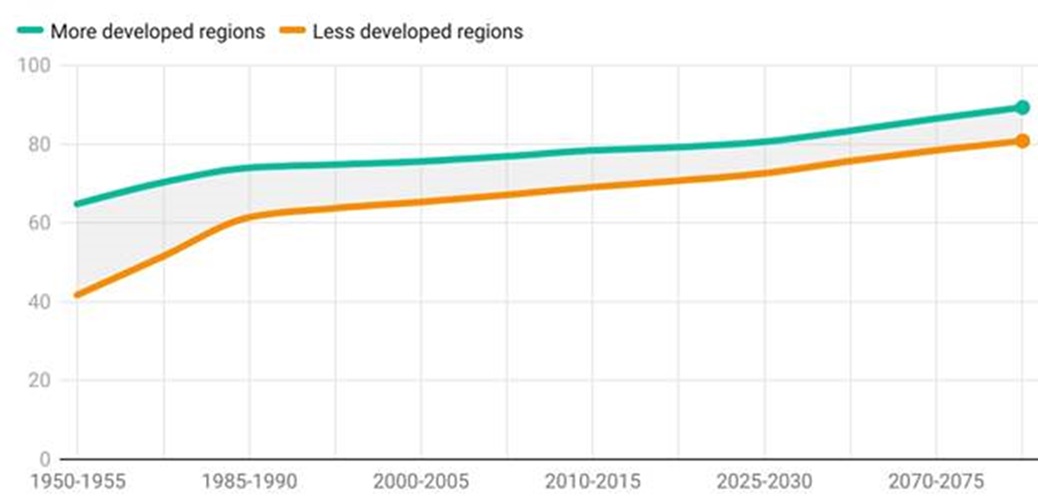
Source: UN Department of Economic and Social Affairs. Created with Datawrapper.
In South Africa, life expectancy trends mirrored global progress until the 1990s, when the country faced a sharp reversal due to HIV/AIDS. South Africa’s life expectancy fell from ~63 years in 1990 to only ~53 years in 2005, before widespread antiretroviral treatment helped restore it to 65.5 years by 2019.
Overall, the long-term trajectory for most countries is upward, and future projections indicate continued gains. Global life expectancy is expected to reach the high 70’s by 2050. Humanity is experiencing a longevity boom – a triumph of development (advances in medicine, public health, and living conditions)– but one that requires individuals and societies to adapt, particularly in planning for retirement and old age.
The concept of “retirement”
We all grow up with this idea of life, where we go through the cycle of life. We attend school, begin our working careers, start a family, and then, one day, when we are older, we retire. There have been changes to this cycle over time, more recently with people often getting married and starting a family later in life.
The concept of “retirement” is much different today than it was before the 20th century. People used to work until their death or until they reached old age. Today, the concept generally means you can stop working and enjoy the fruits of your labour. The reality, however, is a lot more complex than this, with not all people following the same retirement journey.
Retirement age across the globe
In South Africa, the public sector Old Person’s grant is payable to people aged 60 and older to those who qualify. In the private sector, many employers, through company policies or employment contracts, have a retirement age that ranges between 60 and 65, after which service comes to an end. However, in some circumstances, this age can be extended.
In the US, Congress passed a law in 1983 that increased the full retirement age from 65 to 67, aiming to address rising life expectancy and the financial strain on Social Security. People can start claiming Social Security benefits at the age of 62, but they will receive a reduced monthly payment. Only if they wait until age 67 will they receive the full benefit.
France experienced a period of unrest and strikes as President Macron implemented a retirement reform bill, which increased the retirement age from 62 to 64 by 2030. Their system is a bit more complex than most, but it ultimately came down to gradually increasing the retirement age over time to ensure the system’s sustainability. As the budget minister noted, “Retiring at 62… is just not realistic.”
In the UK, the state pension age (SPA) is currently set at 66 and is scheduled to increase to 67 by 2028 and 68 by 2046. The government is required by UK law to review it regularly. During their 2021 review, they even considered whether the increase to 68 should be brought forward to 2037-39, but this proposal did not make it into the final submission.
This raises an important question regarding the evolution of the retirement age and what a sustainable age at which people can retire is, both to support the public and private systems.
Saving for retirement in an age of longevity
So what does this all boil down to? People are expected to live longer, and developed countries are beginning to raise their retirement age. Longevity risk is one of the most significant risks to retirement planning, as it amplifies all other risks.
There are many approaches to pre- and post-retirement. Regarding pre-retirement, one of the most important factors in deciding whether someone will have enough money saved for retirement is how long they have been contributing and saving for retirement. For this reason, it is so important for younger individuals and families to ensure that retirement savings start with their first salary.
When considering post-retirement, the 4% rule springs to mind. You can withdraw 4% of your retirement savings in your first year of retirement and then adjust this amount for inflation in the following years. This approach offers you approximately an 87% chance of avoiding the depletion of your retirement savings over a 30-year retirement period.
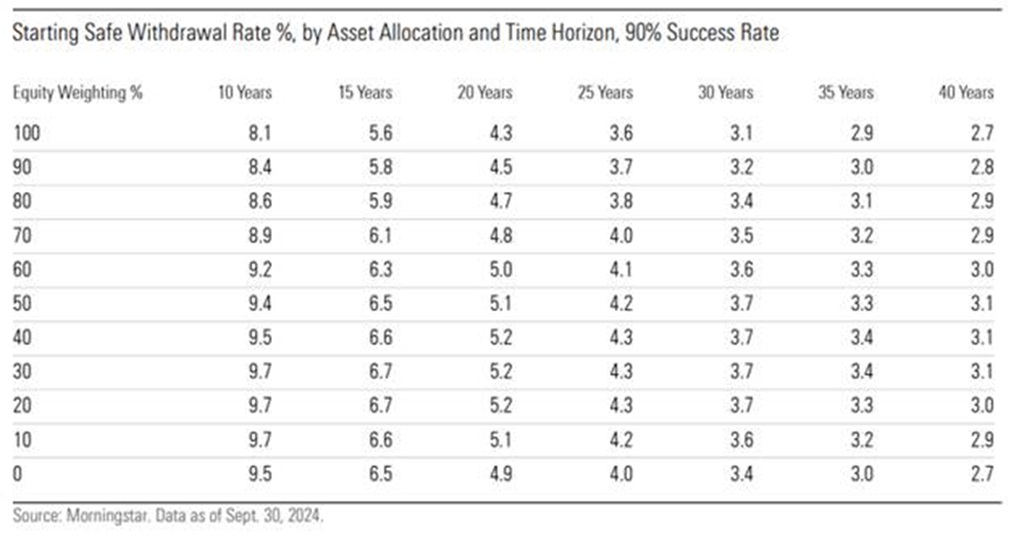
Morningstar’s latest State of Retirement Income 2024 report for the US retirement industry reveals that the “safe” starting withdrawal rate has decreased from 4% to 3.7%. Safe is considered a 90% success rate in which your money does not run out, assuming a 30-year retirement period. This decline is attributed to equities posting the best 15-year period returns since 1970. Consequently, due to the recent robust market performance, valuations are high, which raises the likelihood that future returns may be lower.
It is now more important than ever to consider the risk of people living for longer than anticipated and how this should be approached both pre- and post-retirement. Planning for retirement in the era of longevity requires a proactive and multifaceted approach. We should assume we may live longer than average and err on the side of caution by saving more, investing wisely, and seeking professional advice. At the same time, employers and policymakers will have a role in facilitating this process – through plan design, incentives, and systems that adapt to changing demographics. Retirement planning is evolving into a lifelong process, and those adjustments made now – working a bit longer, saving a bit more, diversifying investments, and insuring against extreme outcomes – will pay off in the form of greater peace of mind in one’s later years. Ensuring financial sustainability for the added years of life is a challenge, but with prudent planning and supportive policy, individuals can enjoy their longevity dividend without fear of running out of resources
ENDS